Ant infestations are a constant problem for homeowners in Fort Myers, and much of that has to do with the region’s warm, humid climate. Unlike colder parts of the country where winter slows pest activity, ants in Southwest Florida remain active and breeding throughout the entire year. Heat, moisture, and frequent rainfall all work together to create ideal conditions for large, persistent ant colonies. When ants begin invading living spaces, professional pest control in Fort Myers is often the most reliable way to eliminate the colony and prevent repeat infestations. Homeowners dealing with ongoing ant problems can benefit from professional pest control services in Fort Myers that target ants at the source rather than just killing the ones that are visible.
Why Ants Thrive in Fort Myers’ Climate
Fort Myers’ subtropical climate provides everything ants need to survive and reproduce continuously. Warm temperatures, high humidity, and frequent rainstorms allow colonies to remain active year-round.
Several environmental factors support constant ant activity:
- Warm temperatures in every season
- High humidity that prevents nests from drying out
- Frequent rainstorms that flood outdoor colonies
- Moist soil that supports tunneling and nesting
Because there is no true off-season for ants in Fort Myers, infestations can begin or worsen at any time of year.
How Heat Accelerates Ant Reproduction
Warm temperatures play a major role in how quickly ant populations grow. Heat speeds up metabolism and breeding cycles, allowing colonies to expand rapidly.
In Fort Myers, ants benefit from:
- Long warm seasons that support continuous reproduction
- Mild winters that fail to suppress populations
- Consistently warm soil temperatures
This means colonies can grow larger and send out more foraging workers throughout the year, increasing the likelihood of indoor infestations.
Why Humidity Makes Infestations Worse
Humidity is another key factor that fuels ant infestations. Ants require moisture to survive, and Fort Myers’ high humidity prevents nests from drying out.
Moist conditions benefit ants by:
- Keeping outdoor nests stable and active
- Supporting survival during dry spells
- Allowing colonies to expand into shaded, damp areas
Homes with moisture issues such as condensation, plumbing leaks, or poor ventilation are especially attractive to ants seeking water.
How Heavy Rain Drives Ants Indoors
Fort Myers receives frequent heavy rainstorms, especially during the summer months. When rain saturates soil and landscaping, ant nests often flood.
When this happens, ants are forced to relocate their colonies to higher, drier ground. Homes provide ideal replacement shelter.
After heavy rain, homeowners often notice:
- Sudden increases in ant activity indoors
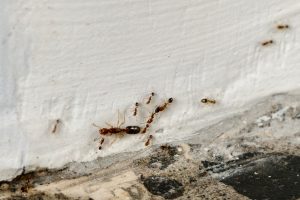
- Ant trails along walls and baseboards
- Ants emerging from cracks and gaps
Rain does not eliminate ant colonies — it simply pushes them closer to human living spaces.
Landscaping Creates Additional Ant Habitat
Fort Myers homes are surrounded by landscaping features that unintentionally support ant populations.
Ants are commonly drawn to:
- Mulch and pine straw beds
- Irrigated lawns and flower gardens
- Dense shrubs and ground cover
- Potted plants and decorative planters
These areas provide shade, moisture, and nesting sites that allow colonies to grow close to foundations and entry points.
Why Ants Enter Homes So Easily
Ants only need extremely small openings to enter a home. In Fort Myers, moisture expansion, settling foundations, and soil movement all contribute to tiny gaps that ants exploit.
Common entry points include:
- Cracks in slabs and foundations
- Gaps around windows and doors
- Utility line penetrations
- Weep holes in stucco
- Sliding door tracks
Once ants locate a food source indoors, they leave scent trails that guide other ants directly into the same area.
Why Ant Problems Escalate So Quickly
Ant colonies contain thousands of workers and one or more queens. Killing visible ants does nothing to stop reproduction inside the nest.
As colonies grow:
- More workers are sent out to forage
- Scent trails become stronger
- Indoor activity increases
- New satellite nests may form
This is why small ant sightings often turn into full-scale infestations within a short period of time.
Why DIY Ant Control Rarely Works Long-Term
Many homeowners attempt to control ants using sprays, traps, and store-bought baits. While these products may kill visible ants, they rarely eliminate the colony.
DIY treatments fail because:
- The nest remains active and hidden
- Queens continue producing workers
- Colonies split and relocate
- Entry points remain open
Without proper identification and targeted treatment, infestations almost always return.
How Professional Ant Control Makes a Difference
Professional pest control focuses on eliminating the entire colony, not just visible ants.
Services typically include:
- Identifying the ant species involved
- Locating nests and foraging trails
- Applying targeted treatments
- Sealing entry points
- Providing preventive recommendations
This comprehensive approach delivers longer-lasting results.
Protect Your Fort Myers Home From Year-Round Ant Infestations
Ant problems in Fort Myers are fueled by the region’s warm, humid climate and frequent rainfall. Waiting too long to act allows colonies to grow larger and infestations to become more difficult to control.
For over 25 years, Pest Solutions Plus has been helping customers solve their pest control problems throughout Southwest Florida. If you’re dealing with persistent ants or want to prevent future infestations, reach out to Pest Solutions Plus to schedule an inspection and learn more about our pest control services in Fort Myers and the surrounding areas.